
What Can AI Actually Do for a UAE Business Right Now – Beyond the Hype?
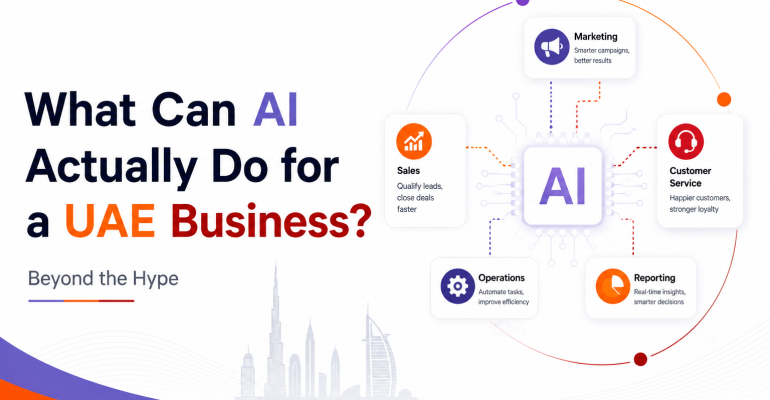
What Can AI Actually Do for a UAE Business Right Now – Beyond the Hype?
 Najam Ahmed
 The short answer: AI can make your team significantly more productive today, on writing, research, customer communications, and multilingual content, but only if your people know how to use it. The technology is ready. The training usually isn’t.
Most UAE business owners I speak with are caught between two positions. The first: AI is overhyped and they’ll wait for the dust to settle. The second: AI will automate everything and they need to rebuild their business around it immediately. Both are wrong. What AI can do right now is act as a capable, tireless assistant that makes your existing team faster and more productive. Not a replacement. Not a revolution. A serious productivity lever, if you know where to apply it.
What This Means for UAE and GCC Businesses
The GCC’s workforce is already multilingual by necessity. A clinic in Dubai handles patients in English, Arabic, Hindi, and Tagalog. A real estate firm in Riyadh qualifies leads across multiple languages daily. AI doesn’t just save time on writing tasks here. It solves a communication problem that most Western businesses don’t face at the same scale. That’s one reason the practical upside in this market is higher than global benchmarks suggest.
What the experts are saying
The clearest framework for thinking about AI’s current capabilities comes from Ethan Mollick, Associate Professor at Wharton and author of Co-Intelligence. Mollick argues that AI already improves productivity across writing, analysis, coding, research, and decision-making, not in some future state, but now. His central recommendation is to stop waiting for a comprehensive strategy and start treating AI as a colleague. The value comes from rebuilding how your team works around human-AI collaboration, not from deploying AI as a one-off tool.
Paul Roetzer at the Marketing AI Institute reinforces this. The most immediate return, he argues, comes from AI applied to specific, repeatable tasks: content creation, research, customer service queries, report summaries, and routine workflow steps. Not big transformation projects. Daily tasks your team already does.
Andrew Ng, founder of DeepLearning.AI, has been making a related point for years. AI delivers real results when applied to specific, clearly defined problems. Start with one task that has a measurable before-and-after. That single use case will teach your team more than any broad AI strategy document.
Mustafa Suleyman, CEO of Microsoft AI, puts it plainly. AI will handle many professional tasks, writing, research, analysis, customer support, admin work, but the near-term story is about making your existing people more productive, not replacing them. The businesses that train their teams to use AI well will pull ahead of the ones that don’t.
The numbers back this up. Klarna reduced customer service resolution time from 11 minutes to 2. JPMorgan reviewed 12,000 contracts in seconds, work that previously took 360,000 hours of human time each year. Walmart’s AI forecasting cut food waste by more than 30%. These are real results from businesses that committed to implementation, not just experimentation.
The adoption gap tells a harder story. According to Deloitte’s Middle East research, 66% of organizations in the region report efficiency improvements from AI, but only 34% are using it to change their products or business models in any meaningful way. Consumer behavior is moving faster than business adoption. Deloitte’s Middle East Digital Consumer Trends 2025 found that 58% of consumers in the UAE and Saudi Arabia have already used generative AI tools such as ChatGPT and Gemini, which means your customers are often more familiar with these tools than your own staff. Most AI adoption in the GCC right now is surface-level: a tool here, a shortcut there, with no real change to how work gets done.
The gap that actually matters
Nine out of ten companies say they want to adopt AI. Only one in ten is succeeding. The problem is not the technology. It’s the people. A 2024 global survey found that 62% of organizations cite lack of training as the number one barrier to AI adoption, and that figure has topped the list for six years in a row. Only 32% of organizations have any internal AI training program at all.
Think of it this way: the tools are on the shelf. Most businesses have bought access. What they haven’t done is teach their teams how to actually use them day to day.
That changes how you should think about AI investment. Buying a ChatGPT subscription is not AI adoption. It’s purchasing a login. Real adoption happens when your team changes how they do specific tasks, and keeps doing it that way.
The 10% vs 10x test
There’s a simple way to evaluate any AI use case before you invest time in it. I use this in our AI workshops across the GCC.
10% thinking is about doing the same things faster and cheaper. Drafting a customer email in half the time. Summarizing a meeting in seconds. Pulling together a competitor report without spending a morning on it. These gains are real and they add up, but the business stays essentially the same.
10x thinking is about doing things you simply couldn’t do before. A small legal team that couldn’t handle Arabic contract review now can, without adding headcount. A clinic that couldn’t produce patient materials in four languages now does it at scale. A property developer that qualified 20 leads a day now qualifies 200. The business can offer something it couldn’t offer last year.
Both types of thinking matter. But if your team only ever uses AI for 10% gains, a competitor who pushes into 10x territory will eventually change the conversation.
The financial case for even the smaller gains is real. A five-person marketing team saving 15 hours a week on content work, proposals, emails, social copy, internal reports, is saving roughly AED 6,000 a month at AED 100 an hour. That’s before anything strategic comes into the picture.
What to do next
The most common mistake GCC businesses make with AI is treating it as an abstract question rather than a practical one. “Should we adopt AI?” is not a useful question. “Which tasks does our team repeat every week that AI could speed up?” is where to start.
Here’s a straightforward path to getting started without wasting the first three months:
- Run a task audit with your team. Ask each person to write down their five most time-consuming weekly tasks. Focus on anything involving writing, research, summarizing, translating, or formatting. Those are your first AI use cases.
- Pick one task and run a 30-day test. Measure time before and after. Don’t try to change everything at once.
- Test the multilingual capability on something real. Write a client message in English, then ask the AI to produce a version in Arabic suited to a formal GCC business context. Judge the output honestly.
- Build one reusable prompt your whole team can use. A well-written prompt for your most common task, whether that’s proposal drafting, client emails, or meeting notes, becomes a shared team resource.
- Get proper AI training before buying more tools. The bottleneck is almost never access to tools. It’s knowing what to do with them.
These five steps take less than a week to complete. Most businesses that work through them identify two or three clear AI use cases within the first hour of the task audit.
Mapping this against your specific business, your team, your workflows, your GCC market context, is exactly what our AI 101 Workshop is built for. No technical background required.
What This Means for GCC Businesses in 2026
AI gives businesses in this region a practical edge that goes beyond what most international benchmarks capture. The multilingual demands of the GCC market, Arabic and English communications, staff and customers across a dozen nationalities, are problems AI handles well. The businesses that move from experimentation to structured adoption this year will find that gap harder to close in two years’ time.