
How Google Ads Auction works? Bidding, Quality Score, and Ad Rank
How Google Ads Auction works? Bidding, Quality Score, and Ad Rank
 Najam Ahmed
 What Is Google Ads Quality Score and Why Does It Affect How Much UAE Businesses Pay Per Click?
The short answer: Quality Score is Google’s diagnostic signal for how well your ads and landing pages match what people are searching for. Higher quality means lower CPC for the same position. In high-CPC markets like Dubai and Riyadh, getting this right saves real money — tens of dirhams per click, not fractions of a penny.
Google charges you more when your ads and landing pages are poor matches for what people are searching for. That’s been true since the beginning of paid search. What’s changed is how much complexity sits around it now — AI-driven bidding, broad match expansion, AI Max campaigns — all of it making the relationship between quality and cost harder to see but no less real. For UAE businesses running ads in some of the most expensive search markets in the world, understanding what drives Quality Score isn’t optional. It’s where budget gets saved or wasted. If your team manages campaigns in-house, our Google Ads training covers this in full.
What This Means for UAE & GCC Businesses
Dubai and Abu Dhabi consistently rank among the highest CPC markets globally for healthcare, legal, and real estate searches. A Quality Score improvement that might save a UK advertiser a few pence per click can save a UAE clinic or law firm tens of dirhams. The financial stakes are proportionally higher here. Across the GCC, many businesses are running campaigns originally set up in a hurry, with generic copy and landing pages that haven’t been touched since launch. That’s where the money goes.
How Quality Score actually works
Quality Score is a 1–10 rating Google assigns to each keyword in your account. It reflects how relevant your ad and landing page are to someone searching that term. The number itself appears in your account as a diagnostic signal. What it does not do is enter the auction directly.
Ginny Marvin, Google Ads Liaison, is clear in Google’s official documentation: the metric displayed in your account is a historical aggregation, not a live input. The auction uses real-time quality signals, not the stored number. That’s an important distinction. If you’ve been pausing campaigns to “reset” your Quality Score, you’ve been wasting time.
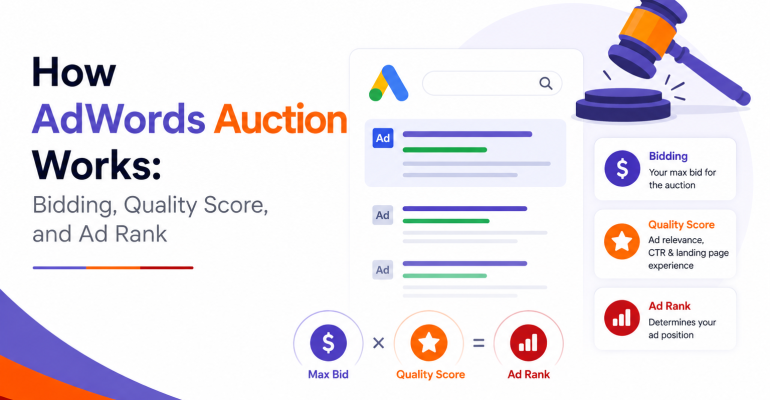
What does enter the auction is Ad Rank — and this is where quality has its actual effect on cost. Ad Rank determines both your position and what you pay. Jyll Saskin Gales, former Googler and independent Google Ads coach, put it plainly in Search Engine Land in February 2026: “Ad Rank = price × quality.” The implication is mechanical. If your quality is low, you pay more to achieve the same position as a competitor with better quality. If your quality is high, you can hold position at lower cost.
Her framing from the Inside Google Ads podcast in the same month is equally direct: Quality Score is a diagnostic indicator, not a performance goal. Chasing a 10/10 is the wrong objective. The score tells you something is wrong. It doesn’t tell you what to do about it.
The three factors behind the number
The displayed score aggregates three underlying components: expected click-through rate, ad relevance, and landing page experience. Each is rated as above average, average, or below average. Each one affects Ad Rank independently.
Expected CTR measures how likely Google thinks people are to click your ad for a given search. It’s based on your historical performance adjusted for position. If your ad copy doesn’t give people a strong reason to click, this component drags your Ad Rank down — meaning you pay more for the same position, or lose it entirely.
Ad relevance measures how closely your ad matches the intent behind the search. Brad Geddes, co-founder of Adalysis and author of Advanced Google AdWords, has written extensively on this: improving all three underlying drivers — particularly expected CTR and ad relevance together — is what achieves better visibility at lower CPC. The score is a symptom. The drivers are the treatment.
Landing page experience is where most accounts quietly lose points without realizing it. Google evaluates whether your page delivers on the promise of the ad, whether it loads quickly, whether the content matches what the user expected. Navah Hopkins, paid media expert and regular industry voice, consistently pushes the same message: stop optimizing toward the numeric score and start optimizing the three underlying drivers. The score follows; it doesn’t lead.
Where experts agree — and where the picture gets more complex
The consensus across Gales, Geddes, Hopkins, and Frederick Vallaeys — co-founder of Optmyzr and former Google AdWords Evangelist — is that Quality Score remains a useful diagnostic. The factors behind it still govern cost efficiency. That hasn’t changed.
What has changed is the environment around it. Vallaeys, writing for Optmyzr in March 2026, notes that the core question Quality Score asks — do your ads and landing pages reflect a genuine user experience? — is still the right one. But broad match expansion and the growing use of AI Max campaigns mean more search queries are being matched to your ads than a tightly controlled exact-match account would allow. More query variation means more quality variation. The score can look stable at keyword level while quality is actually fragmenting across a wider range of matched searches. Both Vallaeys and Gales note this makes the displayed score feel blunter than it used to. Neither says it stopped mattering. They’re both saying you need to look more carefully at what’s underneath it.
The part global experts miss about the GCC
The expert consensus is sound. What it doesn’t account for is the specific failure mode that runs through UAE and broader GCC campaigns.
The first is poor account structure. A single ad group with dozens of unrelated keywords — leather sofas, rugs, dining tables, patio furniture — all served by one generic ad. One ad cannot be relevant to all those different searches. Expected CTR drops across every keyword. Ad relevance drops. Quality Score suffers on the entire group. This is one of the most common mistakes in UAE SME accounts, and it costs money every single day the account runs unchanged.
The second version of the same problem shows up in service businesses. A lot of UAE advertisers — particularly SMEs and clinics who set up accounts without Google Ads consulting or specialist support — are running the same ad copy across keyword groups with very different intent. I see it regularly. A dental clinic in Dubai running one ad for “dentist Dubai” and the same ad for “teeth whitening Dubai.” Those are two different searches. One person wants a regular practice. The other has a specific cosmetic outcome in mind. Generic copy serves neither well. Expected CTR drops. Ad relevance drops. Quality Score drops across both keywords. And because Dubai healthcare CPCs are already high, the cost penalty compounds.
The third pattern is bidding obsession. Business owners read about Smart Bidding, set Target CPA or Target ROAS, and assume the machine will handle everything. It handles what it can. It cannot fix a landing page that loads slowly, talks about the practice history instead of the treatment the user searched for, and buries the phone number at the bottom. Landing page experience is the component where I see the most unaddressed losses in GCC campaigns.
The practical translation: if your campaign is spending but CPCs feel too high relative to your position, don’t adjust bids first. Pull your Quality Score diagnostic. Find which component is below average. Fix that.
What to do next
Quality Score improvements compound over time — a single round of fixes can hold for years. The steps below are ordered by impact, not complexity. Most UAE accounts will see movement within the first two.
- Go to your Google Ads account, open the Keywords tab, and add the Quality Score, Expected CTR, Ad Relevance, and Landing Page Experience columns. You cannot fix what you cannot see.
- Sort by “below average” landing page experience. These keywords are costing you the most in wasted CPC. Open each landing page and ask whether someone searching that keyword would find exactly what they expected within three seconds of landing.
- Group keywords by intent, not just by service. “Dermatologist Dubai” and “skin rash treatment Dubai” are different searches. Write separate ads for each intent group. Ad relevance and expected CTR both improve when copy matches intent precisely.
- Run a search terms report. For any keyword using broad or phrase match, check what queries are triggering your ads. Poor-quality matched queries drag down expected CTR. Add negatives, or tighten match types on your highest-spend keywords.
- Check your mobile landing page separately. Google weights mobile experience heavily in landing page scores. A page that looks fine on desktop can perform poorly on mobile — and in the UAE, mobile search volume is high across most sectors.
- Align your page metadata with your ad copy. Your meta titles, page headers, and ad headlines should reflect the same search intent. When they do, Google can verify that your landing page delivers on what your ad promised — and landing page experience scores improve as a result. This is one of the least-used Quality Score improvements available to UAE businesses running both SEO and Google Ads simultaneously.
Fix the components first. The score will follow.
In high-CPC markets like Dubai and Riyadh, Quality Score improvements deliver larger absolute savings than in most Western markets. Fixing a below-average landing page experience in a UAE healthcare campaign can move the needle by tens of dirhams per click.
If your UAE or Saudi campaign is spending but CPCs feel disconnected from your position, the Quality Score diagnostic is the right starting point. Our Google Ads consulting work starts there — or get in touch directly if you want a quick account review.