AI Sounds Confident Even When It’s Dead Wrong. Here’s Who Catches It.
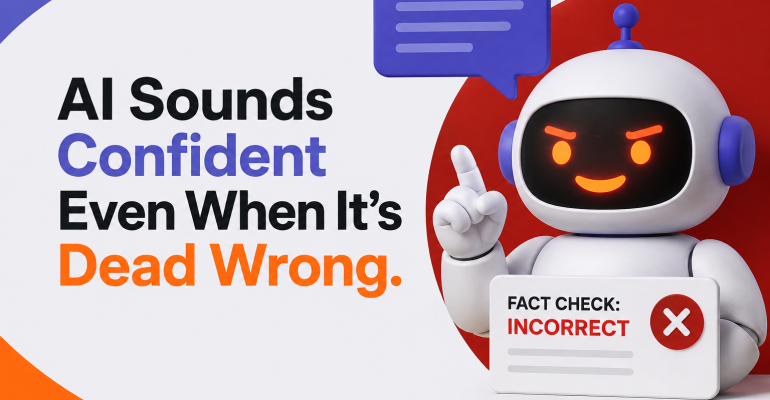
AI Sounds Confident Even When It’s Dead Wrong. Here’s Who Catches It.
 Najam Ahmed
 AI doesn’t sound like it’s guessing. It never hesitates. It never says “I’m not sure about this part.” Every answer arrives with the same confident tone, whether it’s right or completely off.
That’s the part that gets businesses in trouble.
A retail business in Abu Dhabi found this out the expensive way this year.
They had been paying an agency to manage Google Ads. Solid results. Nothing dramatic, just steady month over month.
Then someone showed the owner that ChatGPT could write ad copy. Someone else showed him a tool that could set bids automatically. He did the math and cut the agency.
Three weeks later, cost per lead had tripled. The campaigns were burning budget on keywords that had nothing to do with what the business actually sold. Every recommendation the AI made had sounded reasonable. None of them were checked by anyone who knew what “reasonable” was actually supposed to look like for that account.
Nobody left on staff knew enough about Google Ads to notice until most of the month’s budget was already gone.
AI didn’t cause this. It multiplied what was already missing.
What AI actually multiplies
Ethan Mollick, the Wharton researcher behind Co-Intelligence, describes AI’s ability as a jagged frontier. Excellent at some tasks. Quietly wrong at others. The line between the two is rarely obvious unless you already understand the subject.
That’s the part missed in most “AI will handle it” pitches. Evaluating what AI produces requires the same subject matter expertise the task required before AI existed. Mollick’s own conclusion, after years studying this professionally, is blunt: expertise becomes more valuable in an AI-driven world, not less.
Put an experienced Google Ads specialist in front of AI tools and campaigns get built faster, with sharper targeting and cleaner copy. Put someone with no background in front of the same tools and the output looks equally confident. Nobody in the room can tell the difference until the money’s already spent.
The lawyer example nobody in SEO thinks applies to them
Law is the clearest proof this isn’t a marketing problem, it’s a human problem.
By June 2026, a public database tracking 1,598 hallucination cases in court filings worldwide, growing at roughly eight new ones a day.
These aren’t obscure cases. In April 2026, the Alabama Supreme Court sanctioned an attorney who had filed briefs full of citations to court cases that didn’t exist, after he had already been warned and promised it wouldn’t happen again. One Colorado attorney tried blaming an unnamed intern for the fabricated cases in his own filing. The court suspended him for two years anyway. Supervision rules put the signing lawyer on the hook regardless of who actually ran the prompt.
That’s the pattern worth sitting with. The tool made the mistake. The professional wore it.
Where full automation without supervision breaks down
The same failure shows up across every regulated or reputation-sensitive field, not just law.
- Legal. AI drafts a brief with citations that sound real. Nobody who understands case law checks them before filing.
- Healthcare. AI drafts patient communication or documentation. Nobody with clinical training reviews it before it reaches a file or a patient.
- Accounting. AI reconciles or flags transactions. Nobody with the accounting background catches the one flag that was wrong in a way only a trained eye would notice.
- SEO. AI recommends link-building tactics or technical fixes. Nobody who understands search penalties reviews what’s about to go live on the domain.
- Google Ads. AI sets bids and writes copy. Nobody who understands the account’s actual customer reviews where the budget is heading.
Full automation without supervision doesn’t remove errors. It removes the person positioned to catch them.
Why UAE speed makes this sharper
The UAE isn’t just adopting AI. It’s adopting it faster than almost anywhere on earth. Workplace AI usage crossed 70 percent in early 2026, more than four times the global average.
That speed is a genuine advantage when it’s paired with expertise already in the building. It turns into a liability fast when it isn’t. Most UAE CEOs report they’re redesigning roles specifically to integrate AI alongside their existing teams, not to replace them. The businesses getting hurt are the ones skipping that part and assuming the tool covers the gap on its own.
The two mistakes I keep seeing
The first mistake is cutting the person and keeping the tool. A business assumes AI covers what a specialist, an agency, or a trained employee used to do, and finds out three months later that nobody was checking the work.
The second is subtler. A business keeps the expert but never lets them near the AI tools, treating AI as something for junior staff to figure out while the experienced person keeps doing things the old way. That wastes the entire advantage. The expert is exactly the person who should be using AI, because they’re the only one who can tell when it’s wrong.
You’re responsible for whatever AI produces under your business name. Not the tool. Not the intern who ran the prompt. You. That doesn’t change based on how confident the output sounds.
What to do next
None of this means slowing down on AI. It means putting it in the hands of people who already know the domain.
- Identify who on your team has real expertise in the function you want AI to speed up, whether that’s ads, content, finance, or operations.
- Give that person the AI tools first, not last. They’ll catch mistakes a novice won’t even notice.
- Before cutting an agency or a role, ask directly who reviews AI output before it goes live, and get a specific answer, not a reassurance.
- Treat AI output the same way you’d treat a junior hire’s first draft. Reviewed, corrected, and approved by someone who knows the subject, every time.
This isn’t a one-time policy. It’s a habit that has to hold even after the novelty wears off.
Cutting costs by removing the expert and keeping the AI subscription looks identical to progress for a few weeks. It rarely stays that way, and in a market moving as fast as the UAE’s, the gap between businesses that pair AI with real expertise and those hoping AI replaces the need for it is going to show up in the numbers faster here than almost anywhere else. If you want a second opinion on where your team’s expertise and your AI tools actually connect, that’s the exact gap our AI workshop executives is built to close.