Nobody Saw This AI Job Coming, and Now Everyone’s Hiring for It
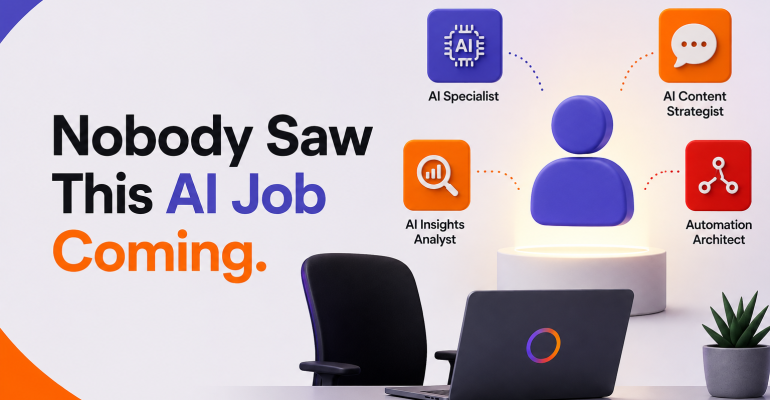
Nobody Saw This AI Job Coming, and Now Everyone’s Hiring for It
 Najam Ahmed
 Two years ago, this job didn’t exist. Now it pays six figures, companies are scrambling to fill it, and the person qualified for it was probably already on your payroll before AI showed up.
A logistics company in Dubai found this out the hard way earlier this year.
They cut their content and marketing team down to one person and an AI subscription. The thinking made sense on a spreadsheet. Blog posts, social captions, even client updates could be generated in minutes. Why keep paying three salaries.
Three months in, the leftover marketer was spending most of her week fixing what the AI produced. Wrong pricing mentioned in a post. A client’s name misspelled in an automated email. Content that technically made sense but sounded like nobody who worked there had actually written it.
The company didn’t rehire the old team. It hired one senior marketer back, in a different role. Her job now is reviewing everything before it goes out, correcting it, and deciding what actually ships. Everyone else on the account still uses AI daily. She’s the one accountable for what it produces.
Nobody wrote a job description for this a few years ago. Now it’s one of the fastest-growing titles in the market, and most business owners haven’t clocked it yet.
What’s actually happening to hiring
The dominant narrative is still “AI is going to eliminate jobs,” and there’s real data behind that concern. Seventy-one percent of professionals surveyed globally in early 2026 believe AI will eliminate more jobs than it creates, according to the State of AI for Business report. That’s not a fringe view. It’s close to consensus.
But look at what companies are actually hiring for, and a different picture shows up next to it. Job postings for AI manager roles grew more than 140 percent year over year, with salaries running from $135,000 to over $200,000 depending on seniority, in roles that blend strategic oversight and governance rather than deep technical coding. These aren’t engineering roles. They’re oversight roles, filled by people who already understood a business function before AI arrived.
Both things are true at once. Fewer people doing the old version of a job. More demand for the person qualified to review, direct, and approve what the AI version of that job produces.
What this looks like per function
The person qualified to supervise AI output in any domain is the same person who was qualified to do that job manually before AI existed. The title changes. The underlying expertise doesn’t.
- Finance. Someone who understood reconciliation and reporting before AI now reviews AI-generated reports for the errors only a trained eye catches.
- SEO. Someone who understood how search rankings actually work now reviews AI-suggested technical fixes and content before anything touches a live domain.
- Google Ads. Someone who understood account structure and customer intent now reviews AI-set bids and AI-written copy before budget goes out the door.
- Content and marketing. Someone who understood brand voice and audience now reviews AI drafts for tone, accuracy, and whether it actually sounds like the business.
Employers are increasingly hiring for this kind of AI literacy rather than for a specific job title, where demonstrating practical, hands-on AI skill matters more than having “AI” in a previous role. The skill being hired for is judgment, applied to AI output, inside a domain the person already knows.
Why this matters more in the GCC right now
The UAE isn’t just adopting AI fast. It’s building a labor market around it faster than most economies.
AI-related job postings in the UAE rose from roughly 1 percent of all postings in 2021 to 3.2 percent in 2025, with the country now ranked among the fastest-growing markets globally, according to the AI Jobs Barometer. UAE CEOs remain confident enough about this shift that 84 percent plan to expand headcount over the next three years, not shrink it, alongside 92 percent expressing confidence in their own AI governance compared to 76 percent globally.
That confidence isn’t blind optimism. It’s built on the same principle showing up in the finance and SEO examples above: pair AI with expertise, and headcount grows because the work being produced is better, not because the headcount is padding for show.
The mistake I see business owners make
Every executive I train asks some version of the same question. Do we cut the team now that AI can do the work.
The honest answer is almost never a straight yes or no. It depends entirely on whether anyone remaining understands the work well enough to catch AI when it’s wrong. A team of five doing manual work can sometimes become a team of two doing supervised AI work, and that’s a legitimate, often smart shift. A team of five becoming a subscription and nobody checking the output is a different decision entirely, and it’s the one that quietly costs businesses the most.
The mistake isn’t using AI aggressively. It’s removing the reviewer at the same time you add the tool.
What to do next
Building this into a hiring or restructuring decision takes a few concrete steps, not a vague AI strategy document.
- Identify who on your current team has the deepest domain expertise in each function AI is touching, whether that’s ads, content, finance, or operations.
- Reframe that person’s role explicitly around review and direction, not just production, and make it part of their actual job description.
- Before cutting a role because “AI can do it,” name who will review the AI’s output going forward, specifically.
- Track error rates on AI-assisted work for the first ninety days the same way you’d track a new hire’s ramp-up period.
This is a staffing decision, not a technology decision, even though it gets framed as the second one constantly.
The UAE’s AI job market is growing quickly enough that the businesses figuring this out now will be the ones with a genuine hiring advantage in eighteen months, not the ones scrambling to rehire the expertise they cut too early. If your team is weighing exactly this kind of restructuring decision, that’s the specific conversation our AI workshop executives is built around.