How Is AI Changing SEO in 2026 – and What Do GCC Businesses Need to Do Differently?
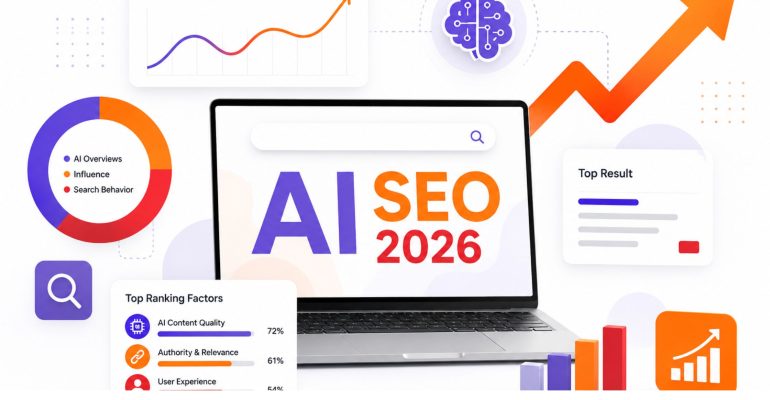
How Is AI Changing SEO in 2026 – and What Do GCC Businesses Need to Do Differently?
 Najam Ahmed
 SEO hasn’t died. It has split. One half still looks like the SEO you know: technical structure, crawlability, topic clusters, on-page signals. The other half looks nothing like it — brand recognition, LinkedIn authority, YouTube presence, and whether AI systems have enough evidence to trust your business enough to cite it.
Every expert I follow is saying some version of the same thing: the goal is no longer to rank first. The goal is to be cited within the answer. Most GCC businesses have no strategy for that yet.
What This Means for UAE & GCC Businesses: When a business owner in Dubai, Riyadh, or Kuwait City asks ChatGPT or Perplexity for an SEO consultant recommendation, Google rankings don’t determine that answer. Brand signals, content authority, and multi-platform presence do. The bilingual dimension adds another layer — Arabic and English AI search intent differs for the same query, and most businesses are optimising for neither language properly. The firms that close this gap in 2026 will be very difficult to displace.
What the Experts Are Saying
Where Most Experts Agree: The Rules Have Shifted, Not Disappeared
The consensus among practitioners is clear: the fundamentals haven’t gone away, but what sits on top of them has changed entirely.
Aleyda Solis — International SEO Consultant, Crawling Mondays (2025–2026)
Generic content is worthless now. That is Solis’s consistent position, and the reasoning is straightforward: AI tools have commoditised it. What differentiates a site in 2026 is first-party expertise — real insight, real data, real experience — combined with technically clean architecture that both human visitors and LLM retrieval systems can process.
Her work on semantic clarity and entity-based SEO has become increasingly central as AI systems rely on structured, crawlable information to determine what a site is actually about.
Barry Schwartz — Founder and Editor, Search Engine Roundtable (2025–2026)
Schwartz has documented the practical consequences of AI-driven search more granularly than almost anyone. Two things stand out from his reporting: analytics are becoming unreliable because AI influences decisions without generating trackable clicks, and businesses chasing AI-SEO shortcuts are losing ground to those with clean technical foundations.
His coverage of the 2025 Web Almanac data is particularly useful — blocks on GPTBot are up 55% year-on-year, ClaudeBot nearly doubled, and FAQPage schema adoption keeps rising because structured answers now serve AI retrieval systems, not just Google SERPs. Technical SEO is no longer just about Google.
Mike King — Founder and CEO, iPullRank (2025–2026)
King’s shorthand is the most precise framing I’ve come across: SEO is now retrieval optimisation. The question isn’t just “does Google rank this page?” — it’s “can an AI system extract, understand, and confidently cite this content?”
That requires entity-based content strategy, semantic relationships between topics, and structured information that LLM systems can parse. Businesses still writing for keyword density are writing for a search model that is receding.
Adobe Research — Digital Experience Blog (2025–2026)
Adobe’s data adds a commercial dimension the other experts don’t quantify: AI-referred visitors browse 12% more pages per visit and show a 23% lower bounce rate than non-AI referrals. Getting cited by AI isn’t just a visibility play — it converts better than standard organic traffic.
Where Experts Diverge: The Traffic Model Debate
Not everyone agrees on how serious the damage to organic traffic actually is — and that tension is worth understanding before you restructure your entire strategy.
Rand Fishkin — Founder and CEO, SparkToro (2024–2026)
Fishkin’s 2024 Zero-Click Search Study put a number on what many suspected: for every 1,000 Google searches in the US, fewer than 375 clicks go to the open web. His conclusion is direct — stop depending on Google traffic as your primary discovery channel. Build brand recognition through newsletters, YouTube, podcasts, and community platforms.
Worth noting: his data also shows total search volume is rising in parallel. The percentage of clicks going to the open web has dropped, but the absolute number hasn’t collapsed. The trend is real. The catastrophe is not inevitable.
Lily Ray — VP, SEO Strategy and Research, Amsive (2025)
Ray’s work on Answer Engine Optimisation makes the brand problem explicit. AI systems evaluate authority, trust, and expertise signals across the entire web — not just on-site content. Your LinkedIn presence, your YouTube channel, your mentions in industry publications, your Reddit activity — all of it feeds into whether an AI system considers your brand credible enough to surface.
SEO is no longer a website problem. It’s a brand problem.
Neil Patel — Founder, NP Digital — Survey of 9,210 Marketing Professionals (2026)
Patel’s dataset is the largest in this roundup and the most concrete on where budgets are actually moving. Investment in AI SEO jumped 98% — the largest growth sector in the entire study. His framing: optimisation has completely pivoted from earning standard website clicks to positioning brand data to be cited as the authoritative source inside an AI engine’s answer.
He also found that 64% of marketers are cutting organic social spend as platforms transition from follower-based networks to interest-based media. Attention is consolidating around high-intent, high-trust environments.
HubSpot Research — State of Marketing Report (2026)
HubSpot’s data offers a counterweight to the doom narrative. In their 2026 State of Marketing report, 73% of SEO professionals said AI tools are becoming an important part of their strategy — but 60% also said website traffic growth is actually easier to improve now than it was 10 years ago.
The panic about AI destroying SEO is not uniformly shared by the people doing the work.
John Mueller — Search Advocate, Google Search Relations (2025)
Mueller’s position is the clearest counterpoint to the noise. Nothing fundamental has changed in what Google wants: original content, created for people, that demonstrates genuine expertise. He cautions against chasing AI-SEO tactics that are more noise than signal.
The mechanism for surfacing good content is changing. The underlying requirement is not.
Fishkin and Mueller aren’t contradicting each other. Mueller is right that good content is still the foundation. Fishkin is right that good content alone won’t generate the traffic it once did. Both are necessary. Neither is sufficient on its own.
My Take After 27 Years in Digital Marketing
I agree with the consensus. I also think it describes a shift that most GCC businesses haven’t started thinking about.
In my SEO consulting work across the UAE and Saudi Arabia, the dominant mindset is still “get me to page one on Google.” The businesses asking me how to rank are often the same businesses with no YouTube channel, no LinkedIn content strategy, no digital PR presence, and no structured plan for building the kind of multi-platform brand that AI systems will recognise and cite.
Pillar clusters and topical architecture still matter — a well-structured content strategy signals to both Google and AI systems that your site has genuine depth. But structure without expertise inside it is hollow. If the content reads like it could have been written by anyone, it won’t be cited.
This is where E-E-A-T becomes the most practically useful lens for GCC businesses. A healthcare professional writing about a treatment protocol carries different weight than a content team summarising WebMD. A consultant who has run Google Ads campaigns for UAE clinics for 17 years has something to say about local advertising regulations that no international expert can replicate. That specificity is what gets cited.
It’s also what I teach in my AI workshops across the UAE — the goal is no longer to rank first, it’s to be cited within the answer, and that requires showing who you are, not just what you know.
UAE-specific data compounds this. Local statistics, market observations, and real client examples from Dubai or Riyadh ground your content in a way that AI systems can verify through other regional sources. Generic global figures are forgettable. Local evidence is citable.
Two angles the international experts consistently miss. First, bilingual search: Arabic and English AI search intent differs significantly across the GCC. A Saudi business optimised only for English queries is invisible to Arabic-speaking users asking the same question differently. Second, WhatsApp conversion: GCC businesses convert through WhatsApp, not contact forms. The objective isn’t just to rank or be cited — it’s to become known enough that someone searches for you by name and sends a message. Brand visibility drives that.
What to Do Next
The steps below are not about chasing AI-SEO tactics. They’re about building the kind of presence that AI systems — and real people — consider worth citing.
- Audit your digital presence across platforms, not just your website. Check LinkedIn, YouTube, and at least one industry publication. If your brand doesn’t exist credibly outside your own site, AI systems won’t treat it as an established entity.
- Build topical clusters with genuine expertise inside them. Pillar pages and cluster content still work — but only when the content demonstrates real knowledge from real experience. Make the person behind the content visible and credible. Bylines, author pages, and first-person expertise signals matter now.
- Use E-E-A-T as your content brief. Before publishing, ask one question: does this say something only someone with direct experience in this market could say? If not, it needs work. Local data, real client observations, and GCC-specific context are what separate citable content from forgettable content.
- Test what AI says about your business today. Open ChatGPT or Perplexity and type: “Who are the best [your service] companies in [your city]?” If your business doesn’t appear, you now know exactly where the gap is — and closing it starts with the steps above.
None of this requires a full website rebuild or a new agency. It requires a clear decision: are you building a brand that AI systems can verify, or a website that only you know exists?
To build an SEO strategy that accounts for how AI search actually works in this market, explore our SEO consulting or reach out directly.
The Short Answer: AI is making technical quality and demonstrated expertise more important than ever, while simultaneously reducing direct organic traffic by answering questions inside the search interface. The businesses that adapt build multi-platform brand presence and genuine E-E-A-T signals alongside technical SEO — not instead of it.
The GCC Caveat: Most UAE and Saudi businesses are still optimising for page-one rankings in a world shifting toward AI-cited brand authority. The firms that invest in real expertise, local context, and entity recognition now will have a structural advantage that late movers won’t be able to buy their way out of.