One ad group for all your services? You’re losing clients.
One ad group for all your services? You’re losing clients.
 Najam Ahmed
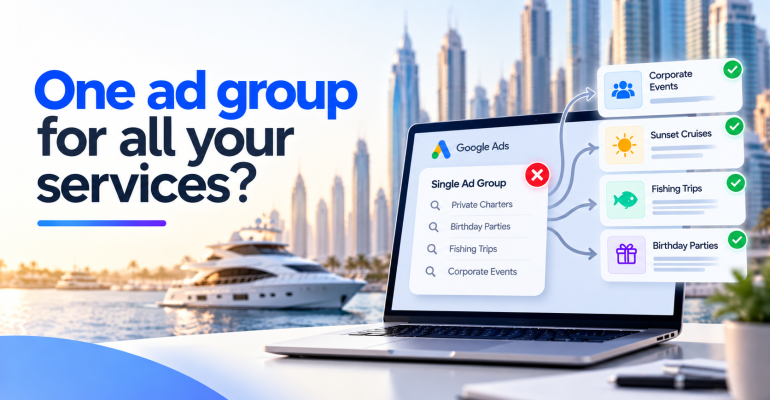
A yacht charter company in Dubai Marina puts every service into one ad group: private charters, birthday parties, fishing trips and corporate events.
An HR manager searches “corporate yacht event dubai.” She sees a headline about sunset cruises for couples, clicks, and lands on the homepage. She leaves, and books with a competitor.
That used to cost you a lower Quality Score and a higher cost per click. In 2026 it costs more. Google’s AI now writes headlines and picks landing pages from whatever sits inside the ad group, so a muddled ad group produces muddled ads automatically.
This post explains what an ad group controls now, how it feeds Quality Score and Ad Rank, and how to structure campaigns for two premium UAE businesses.
The Short Answer: Build one ad group per service, each with its own tightly matched keywords, ads and landing page. Split campaigns when you need separate budgets, locations or languages. Clean structure lifts Quality Score and gives Google’s AI accurate material to write from.
Why structure matters more in UAE accounts
UAE advertisers often serve several emirates, in two languages, and sometimes to buyers who haven’t arrived in the country yet. Dubai and Abu Dhabi can have different prices, demand and competitors.
Arabic searchers need Arabic ads and pages. A single catch-all campaign hides all of that, and gives you no way to fund what works.
What an ad group controls in 2026
An ad group has always tied three things together. Now it does a fourth job.
- Keywords: the searches you want to appear for.
- Ads: the headlines and descriptions people see.
- Landing page: where the click goes.
- The brief for Google’s AI: with AI Max, Google reads your keywords, ads and pages to write new headlines and choose pages.
When all four point at one service, everything lines up. When an ad group mixes services, every one of them gets diluted.
How structure feeds Quality Score
Quality Score has three components, and each one depends on how tightly your ad group is built. We covered how the auction uses them in how the Google Ads auction works.
- Expected CTR: people click ads that repeat what they searched. Someone searching “corporate yacht event” clicks “Corporate Yacht Events in Dubai” far more readily than “Yacht Charters.”
- Ad relevance: how closely the ad matches the keyword. One service per ad group makes this easy.
- Landing page experience: whether the page delivers what the ad promised. A corporate events page with capacity, catering and packages beats a homepage every time.
Two points worth knowing. Quality Score is a diagnostic, not a target, so use it to find weak ad groups rather than chase a 10.
Changing match types also won’t change it, because Google calculates it from exact searches of your keyword. Structure, ads and pages are what move it.
Assets: the part of the ad most accounts leave empty
Ad assets are the extra lines under your ad: links, phone numbers, short benefit lines. Google’s Ad Rank help page lists the expected impact of assets as one of the factors that decide your position. Good assets can win you a higher spot without a higher bid.
Set these up at ad group level where they differ by service:
- Sitelinks to related service pages, the fleet, packages and contact
- Callouts for short trust points such as “Captain and Crew Included” or “Catering on Board”
- Structured snippets listing your services, yacht sizes or areas covered
- Call assets with your business hours
- Message assets, which add a WhatsApp button to your ad. Google lists them as still in beta, so they may not show in every account yet.
Assets written for one service work harder than generic ones shared across the whole account.
What AI Max does with your ad group
If AI Max is on in a campaign, two of its features depend directly on your ad group.
According to Google’s AI Max help page, text customization writes new headlines and descriptions using your existing ads, landing page copy and assets. Final URL expansion can send a click to a different page on your site that it judges relevant to the search and themed to your ad group.
A tight ad group keeps both on track. A loose one invites Google to write vague copy and send people to the wrong page. Keep control with these steps:
- Write each landing page headline so it would work as an ad headline. Google borrows from it.
- Add URL exclusions for pages that should never receive ad traffic, such as blog posts, careers and the homepage.
- If you rely on pinned headlines, turn final URL expansion off. Google says pinned assets may not be respected while it is on.
Whether to use AI Max at all is a separate question, which comes down to the quality of your conversion data.
Example 1: a yacht charter company in Dubai Marina
Yacht charters sell several services at very different values, which makes them a clear structure example. Keywords and page paths below are illustrative; check them in Keyword Planner before use.
Campaign A: Yacht Charters, Dubai, English, Search Network only
| Ad group | Example keywords | Landing page |
|---|---|---|
| Private Charter | [yacht rental dubai], [private yacht charter dubai] | /private-yacht-charter-dubai/ |
| Yacht Parties | [birthday yacht party dubai], [yacht party dubai] | /yacht-party-dubai/ |
| Fishing Trips | [deep sea fishing dubai], [fishing trip dubai] | /fishing-trips-dubai/ |
Campaign B: Corporate Yacht Events, Dubai, English
One ad group with [corporate yacht event dubai] and [yacht for company event dubai], sent to /corporate-yacht-events-dubai/.
Corporate events get their own campaign because one booking is worth several private charters, and the buyer takes longer to decide. A separate campaign carries its own budget and, later, its own cost-per-lead target, so cheaper party enquiries don’t starve it.
This business also has a location twist. Many charters are booked by visitors before they land in Dubai. A third campaign targeting visitors’ main home countries, with “Presence or interest” as the location option, can reach them while Campaigns A and B stay focused on people already in the UAE.
Example 2: a real estate brokerage in Dubai and Abu Dhabi
This one shows why location and language deserve separate campaigns.
Campaign A: Property, Dubai, English
| Ad group | Example keywords | Landing page |
|---|---|---|
| Off-Plan Projects | [off plan property dubai], [off plan apartments dubai] | /off-plan-dubai/ |
| Villas for Sale | [villas for sale dubai], [villa for sale dubai hills] | /villas-for-sale-dubai/ |
| Apartments for Sale | [apartments for sale dubai marina], [buy apartment dubai] | /apartments-for-sale-dubai/ |
| Sell Your Property | [sell my apartment dubai], [property valuation dubai] | /sell-property-dubai/ |
Campaign B: Property, Abu Dhabi, English
The same ad groups with Abu Dhabi keywords such as [villas for sale saadiyat island], and Abu Dhabi ads and pages.
Campaign C: Property, Dubai and Abu Dhabi, Arabic
Arabic keywords such as شقق للبيع في دبي (apartments for sale in Dubai), Arabic ads and Arabic landing pages.
Many UAE phones are set to English even when people search in Arabic, so consider targeting both Arabic and English languages in this campaign. The keywords and ad copy keep it Arabic.
Splitting this way lets you fund Abu Dhabi separately while you test demand, and stops English and Arabic ads competing for the same searches. The “Sell Your Property” ad group also deserves watching on its own, since a seller lead is often worth more to a brokerage than a buyer lead.
When to create a separate campaign
Ad groups split by service. Campaigns split by anything that needs its own settings or budget.
- Location: different emirates, or buyers abroad, with different prices, demand or budgets
- Language: Arabic ads and pages in their own campaign
- Service value: high-value services that need their own budget and cost targets
- Brand: searches for your own name, kept apart so they don’t flatter the numbers
- Testing: broad match or AI Max in its own campaign, so results can be compared
Two settings belong in most Search campaigns. Untick Search Partners and the Display Network.
Under location options, choose “Presence,” so you reach people in or regularly in your area. The exception is a campaign built deliberately for visitors or overseas buyers, like the yacht example above.
Beyond that, keep it simple. On a small budget, every extra campaign splits the data Google needs to learn from.
Structure mistakes I keep finding in audits
- One ad group holding every service the business offers
- Every ad sending traffic to the homepage
- Generic ads with no service name in the headline
- One set of assets shared across unrelated services
- Display Network and Search Partners still switched on
- Location set to “Presence or interest” by default, spending on people with no plan to buy
Each of these is quick to fix, and together they often explain a high cost per lead better than any bid setting.
What to do this week
Open your account and check it against the structure above. A Google Ads audit covers the same ground if you’d rather have it done for you.
- List the services you advertise and check that each has its own ad group.
- Give each ad group its own landing page, with a headline that would work as an ad headline.
- Add sitelinks, callouts and structured snippets at ad group level.
- Split campaigns only where location, language, budget or service value demands it.
- Turn off Search Partners and Display, and choose your location option on purpose.
We teach this setup step by step in our Google Ads, AI and GA4 course.
If you’d rather restructure your account with an expert alongside you, our Google Ads consulting covers it, or message me on WhatsApp.